Tell us about the job
Takes about a minute. No obligation.
Central AC compressors wear through starting cycles, not through sustained runtime, and in this county they almost never run. Homes in Piscataquis County, ME have essentially no cooling season — no month of the year is warm enough to call for it. A compressor that sits idle every summer and then fails when a homeowner finally switches it on failed from something other than overwork: a capacitor that degraded on the shelf, a contactor that corroded over a dormant season, refrigerant that leaked slowly while nobody noticed. A contractor diagnosing that failure checks the electrical components and the refrigerant circuit before touching anything else.
Ductwork laid for a system that no longer exists, and electrical service sized for loads that bear little resemblance to what runs today, are what a contractor steps into on a typical job here. Half the homes in Piscataquis County, Maine were built in 1978 or earlier (2020-2024 ACS 5-year). When a unit is opened for diagnosis, the age of the surrounding house is less relevant than whether the components inside still have a supply chain behind them. Parts for systems retrofitted into housing this old can be scarce, and a repair that looks straightforward on the outside sometimes turns on a part that takes time to source.
The Parts of a Central AC a Contractor Checks First
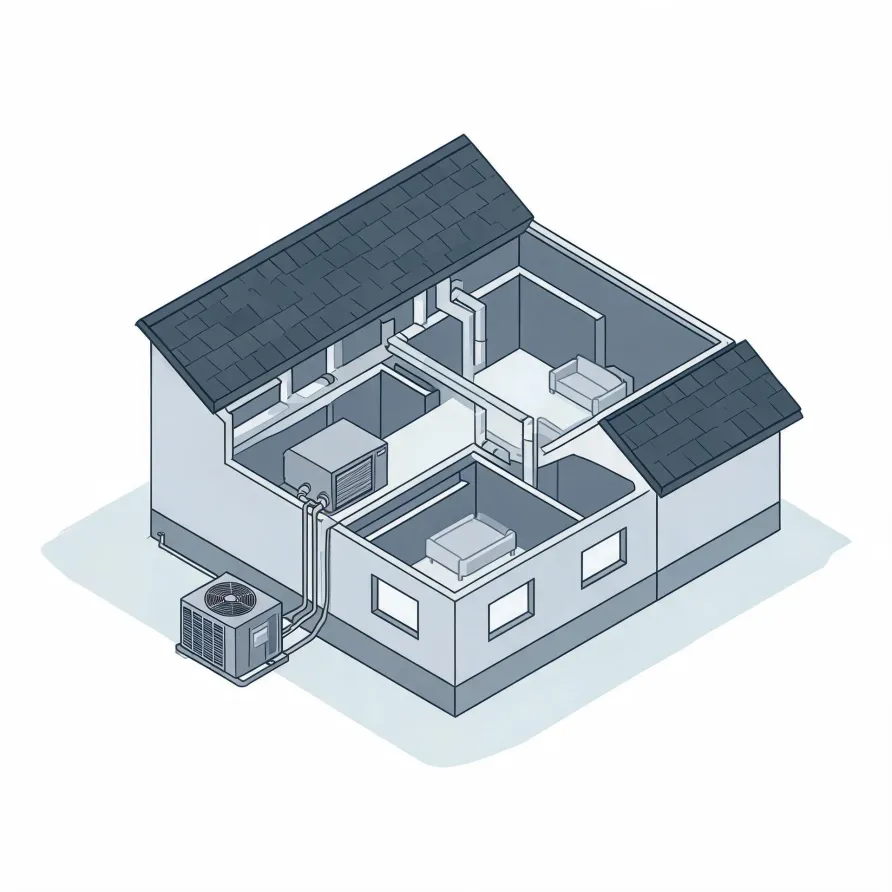
The outdoor condenser unit sits outside the house, usually on a concrete pad or wall bracket, and it carries the compressor and condenser coil. These are the pieces a contractor reaches first when a system stops cooling or starts making noise. The compressor is the part that does the hardest mechanical work, and the condenser coil is where heat leaves the refrigerant.
Inside the house, the air handler holds the evaporator coil and the blower. The air handler typically sits in a basement, utility closet, or attic, and the evaporator coil is where the refrigerant absorbs heat from your indoor air. The blower moves that air across the coil and back through the house. Connecting the two units is the refrigerant line set, a pair of insulated copper lines that run between them and carry refrigerant in both directions.
The drawing shows a general layout of how these pieces relate to one another, and a licensed contractor assesses what applies to the specific system and setup in your home.
Find a contractor in Piscataquis CountyPiscataquis County, by the numbers
227 severe weather events were recorded in Piscataquis County, Maine between 2015 and 2024.
NOAA National Centers for Environmental Information, Storm Events Database, bulk CSV export, events 2015-01-01 through 2024-12-31.Half the homes in Piscataquis County, Maine were built in 1978 or earlier (2020-2024 ACS 5-year).
U.S. Census Bureau, 2020-2024 American Community Survey 5-Year EstimatesPiscataquis County, Maine holds 14,680 housing units (2020-2024 ACS 5-year).
U.S. Census Bureau, 2020-2024 American Community Survey 5-Year EstimatesOwners occupy 78.8% of the occupied homes in Piscataquis County, Maine (2020-2024 ACS 5-year).
U.S. Census Bureau, 2020-2024 American Community Survey 5-Year EstimatesCodes & Standards for Central AC Repair in Piscataquis County, Maine9 sourced rules and standards
What happens when the contractor comes out
Split-system central air conditioners rated below 45,000 Btu/h manufactured on or after January 1, 2023 must meet a federal minimum of 13.4 SEER2.
Split-system central air conditioners rated at or above 45,000 Btu/h manufactured on or after January 1, 2023 must meet a federal minimum of 13.4 SEER2.
Split-system central air conditioners manufactured between January 1, 2015 and December 31, 2022 had to meet 13 SEER, the metric that preceded SEER2.
Single-package central air conditioners manufactured on or after January 1, 2023 must meet a federal minimum of 13.4 SEER2.
Space-constrained central air conditioners manufactured on or after January 1, 2023 must meet a federal minimum of 11.7 SEER2.
Federal efficiency standards for split-system central air conditioners and heat pumps are set on each certified combination of outdoor unit and indoor coil rather than on the outdoor unit alone.
Residential and light commercial air conditioning and heat pump systems assembled in the field, including mini-splits and unitary systems, may not be installed on or after January 1, 2025 using a refrigerant with a global warming potential above 700.
A field-assembled system whose specified components were all manufactured or imported before January 1, 2025 carries no installation compliance date under the refrigerant restrictions and may still be installed.
Licensing and Legal Requirements in Piscataquis County, Maine
Maine licenses the fuel-burning side of heating rather than HVAC as a trade: a Maine Fuel Board licence is required to install or service solid fuel, oil, propane or natural gas burning equipment, including pellet-fired central heating appliances. Air conditioning is not named anywhere in the chapter.
Severe Weather Events in Piscataquis County
Extreme weather puts real load on central AC systems, stressing components and shortening the time between repairs. How much of that pressure a system faces depends on where it sits, and Piscataquis County has its own record.
227 severe weather events, 2015–2024. Source: NOAA National Centers for Environmental Information, Storm Events Database.