Signs of a bad AC capacitor in Maine

Step 1 of 3: Equipment

A bad capacitor usually shows up as an AC that hums but won't start, or one where the fan is spinning but the air isn't cold. Sometimes it shuts off on its own a few minutes after it kicks on. The capacitor stores the charge that gets the compressor and fan motor moving, and once it weakens, the motor doesn't get enough of a push to run right. Heat is part of why it wears out. Even in Maine, where summers don't get as heavy as farther south, a unit that's been cycling on warm afternoons puts real strain on that part over the years. A failing capacitor won't fix itself, and running the system on a dying one can damage the compressor, which costs far more to put right. If your AC is struggling to start or shutting off early, that's the part to have checked.

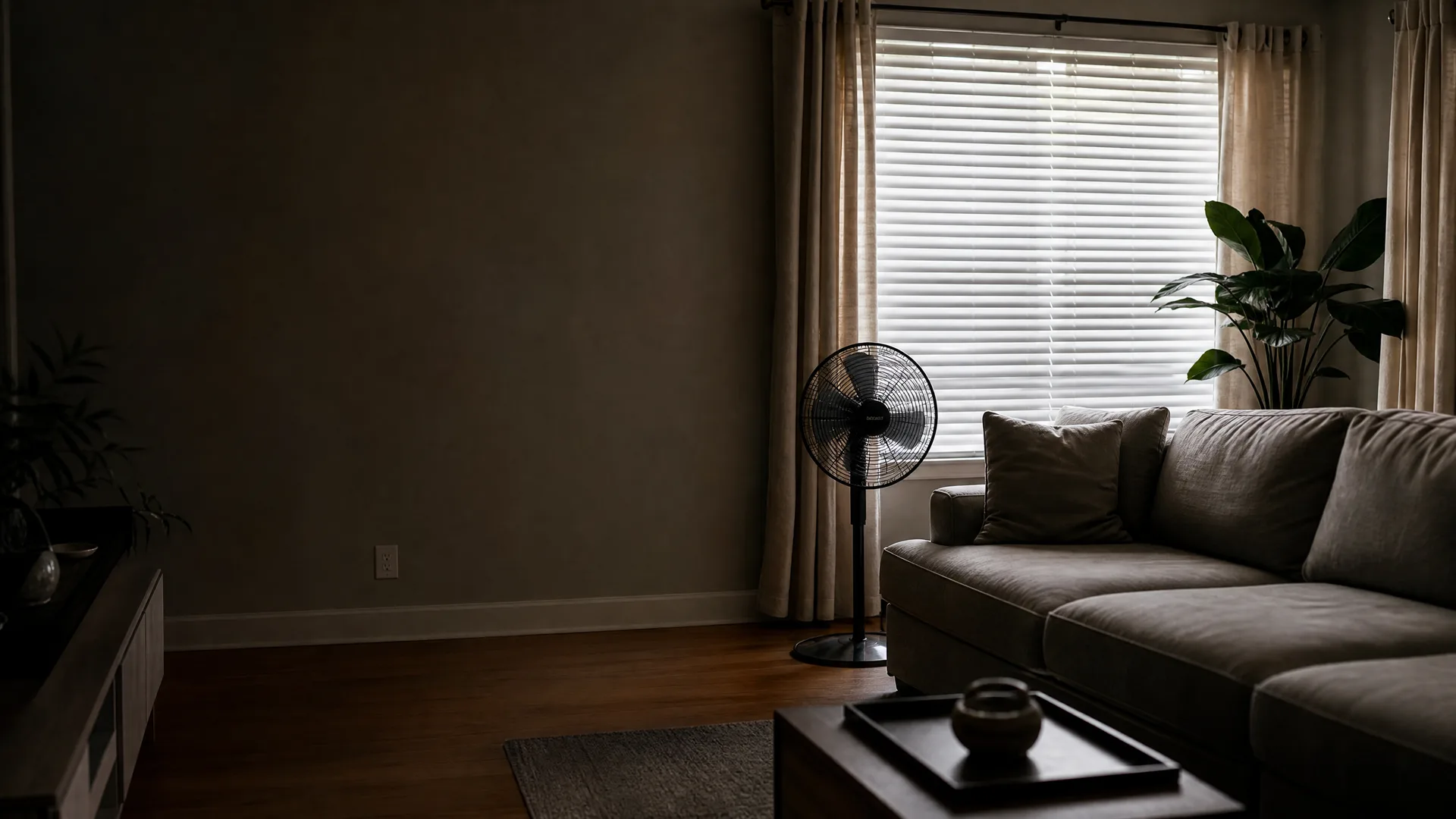
A dimly lit living room with a gray sectional sofa, a standing pedestal fan, a curtained window with blinds, a potted broad-leaved plant, a wooden coffee table with a tray and lidded jar, and a rug on dark wood flooring.

Two o'clock, and the blinds are down against the glare. The floor fan is pushing air across the couch, back and forth, same as it's done all afternoon. You've had it pointed at the kids since lunch. The AC is running, you can hear it humming out there, but the air coming through the vent isn't cold anymore, just moving. You already bumped the thermostat down five degrees and it didn't do anything. Outside the window the light is flat and white, the kind of July afternoon that doesn't let up until six or seven. The fan is doing the work the AC should be doing. You keep checking the vent with your hand, hoping it changed since the last time.

Why does my AC hum but not actually start up?

That humming sound is the motor trying to do its job without the push it needs. You've probably gone out and flipped the breaker, maybe checked the thermostat again, and the unit just keeps making that same noise instead of starting. It's not a mystery once you know what's happening inside the unit, but it's not something you can see from outside the cabinet either.

The capacitor isn't sending the compressor and fan enough of a jolt to get moving

Starting a compressor or fan motor takes a stronger jolt of electricity than running one. That jolt comes from the capacitor. When it's weak, the motor gets power but not enough of it to break free and spin, so it just sits there and hums, drawing current with nowhere for it to go. A good capacitor fires the motor in under a second. A bad one lets it try and fail, over and over, until something trips or the motor overheats and shuts itself off. That strain also runs up your power bill even though the house isn't getting any cooler, which matters more here than most places given what Maine pays for electricity.

A gray outdoor air conditioner condenser unit sits on a concrete pad beside a house with horizontal lap siding, with conduit and an electrical disconnect box on the wall, dark mulch and a shrub to the left, and a concrete walkway in the foreground.

Running the way it should

The unit cycles on, holds steady, and the air coming through the vents is cold. No hum before it starts, no shutting off a few minutes in. It just runs, keeping the house comfortable while the compressor and fan get the steady push a good capacitor gives them.

An outdoor air conditioning condenser unit on a concrete pad beside a house with horizontal lap siding, with a shrub and mulch bed to the left and conduit and a small electrical box on the wall to the right.

A capacitor on its way out

Dirt built up on the grille is one sign a unit has been working harder than it should. Inside, a weak capacitor makes the compressor strain every time it starts, and that strain is what eventually takes it out for good.

Capacitor Fix or Something Bigger

Capacitor problem

  • The hum stops as soon as you give the unit a push of help, like a jump starting the compressor, which points straight at the capacitor instead of the motor itself.
  • The fan inside sits still or spins slow and weak when you'd expect it moving air right away.
  • The unit shuts off a few minutes after starting instead of running through a full cycle.
  • A technician can test the capacitor's charge directly and get a reading that's either within range or clearly failed, no guesswork.
  • Replacing just the capacitor is a smaller job than digging into the compressor or the motor windings.
  • The outside unit may look fine, no burnt smell, no tripped breaker, just a system that won't catch.

Bigger problem

  • The breaker trips every time the AC tries to start, which points at a short or an overloaded compressor rather than a weak capacitor.
  • You smell something burnt near the outdoor unit, a sign the wiring or the motor windings are damaged, not just the capacitor.
  • The compressor hums and tries to start even after the capacitor's been tested and swapped, meaning the motor itself is the issue.
  • Refrigerant lines show frost or ice, which has nothing to do with the capacitor and points at low charge or restricted airflow instead.
  • The system is old enough that other parts are wearing out around the same time, so one repair doesn't mean the unit's done needing work.
  • A contractor finds the compressor itself testing bad, which costs more to fix than a capacitor and sometimes isn't worth fixing at all.
A woman with dark hair in a bun wearing a cream knit sweater sits on a gray sofa in a bright living room, looking off to the side.
A woman wrapped in a knit blanket sits on a gray sofa in a living room, looking toward a bright window with houseplants and an armchair in the background.
A woman in a gray cowl-neck sweater sits on a light sofa with cushions, smiling and looking to the side, with a kitchen and window visible behind her.
A woman with dark hair in a bun, wearing a light linen shirt, sits on a sofa and looks to the side, with a window, houseplants and a kitchen with pendant lights blurred behind her.

A local pro for your air conditioner repair

A capacitor that's failing in July doesn't wait for a better time. Maine summers run warm enough that a dead AC turns a house uncomfortable fast, and with power costing what it does here, you don't want a unit straining on a weak capacitor any longer than it has to, pulling more current while it struggles to start. Figuring out whether it's the capacitor or something else in the compressor usually takes someone who can test it, not guess at it. That's the part that eats your afternoon otherwise: looking up contractors, calling a few, describing the hum and the warm air to each one, waiting on callbacks, then setting the quotes next to each other to see who actually knows the problem. You've already got enough going on without running that whole errand yourself. Send the details once, and a contractor who handles this kind of repair gets in touch with you directly.

What a capacitor check actually involves

  • A capacitor is rated in microfarads, and a weak one drops below that rating as the unit ages.
  • Testing it means pulling it and checking it against a multimeter built for capacitance, not just eyeing the case.
  • A bulging or domed top on the capacitor's casing usually means it's already failed or close to it.
  • Some units run two capacitors in one can, one for the compressor and one for the fan, and either side can fail on its own.
  • A capacitor can test within range cold and still fail once the unit has run for an hour in the heat.
  • Replacing it means matching the microfarad rating and voltage exactly, not just the physical size.

A capacitor has a rating in microfarads, and that number is stamped right on the can. A tech pulls it from the unit and checks it against that rating with a multimeter built for capacitance. A regular meter that reads volts and ohms won't tell you anything useful here. Looking at the case tells you something too. A top that's bulged or domed instead of flat means the capacitor has already failed or is about to. That kind of damage happens from heat and from the strain of running past its years, and it only goes one direction.

Some AC units don't use one capacitor, they use a dual run capacitor, which is really two capacitors built into a single can. One side feeds the compressor, the other feeds the fan, and they fail independently. The fan can spin fine while the compressor side is gone, or the other way around, so a tech checks both sides even when only one symptom shows up.

A capacitor can also pass a test cold and still give out once the unit has been running in the heat for an hour. The reading drifts as it warms, so a check done first thing in the morning can miss a problem that shows up by mid-afternoon. When one does need replacing, the new one has to match the old one's microfarad rating and voltage exactly. The physical size or shape of the can doesn't matter, only those two numbers do.

An outdoor air conditioner condenser unit on a gray composite pad beside a house with horizontal siding, a concrete foundation, a basement window, and a conduit and disconnect box on the wall.
Before you get your air conditioner repair
A gray outdoor air conditioning condenser unit on a concrete pad beside a house with horizontal lap siding and a stone veneer base, with a disconnect box and conduit on the wall, mulch bed and shrub to the right, and mowed grass in the foreground.
After you get your air conditioner repair

Rated in microfarads

A capacitor has a rating stamped on its case. A multimeter built for capacitance can check the actual reading against it, which tells a contractor whether it's still doing its job.

Fill out one form

One failed part, one visit

A capacitor swap is a contained repair, not a teardown of the whole unit. Getting matched means skipping the search for who's available and who you trust to get it right.

Fill out one form

Power costs 27.69 cents per kilowatt-hour statewide

A struggling capacitor makes the compressor work harder to start and run, and that extra draw shows up on your bill fast at 27.69 cents per kilowatt-hour. Letting it limp along costs you more every single day it's not fixed.

EIA-861 2025 statewide residential average

An older woman with gray hair in a bun and glasses, wearing a beige knit sweater, smiles while looking to the side in a warmly lit kitchen, with a loaf of bread on the counter in the foreground and a snowy scene outside the window.
A woman and a child wrapped together in a knitted gray blanket on a couch, with the child's head resting on her shoulder and a lit table lamp and houseplant in the background.
A two-story house with gray and light gray siding, white-trimmed windows and a white front door, flanked by deciduous trees, with a partly browned lawn in front under a clear blue sky.

Maine summers don't carry the thick air you'd get farther south, and the numbers back that up. Averaged across the places people live here, the dew point sits at 59°F for June, July and August, according to NOAA climate data. That's air a capacitor in good shape barely notices. But a weak one is already working harder than it should to get the compressor started, and even mild humidity adds a small extra load on top of that. You might notice the unit cycling more than you'd expect for how mild the air feels outside, or struggling on the warmer, stickier afternoons that still show up between the cooler stretches.

NASA POWER T2MDEW county cells weighted by homes

What are you noticing with your own AC

Walk past the outside unit and listen. A hum with no fan movement, or a fan that's barely turning while the compressor stays silent, both point the same direction. Inside, you might feel air coming through the vents that isn't actually cold, just moving. Some units start fine but shut off again within a few minutes, over and over, instead of running a full cycle. You may have noticed the unit cycling more than usual trying to catch up, which runs your bill higher without actually cooling the house. Left alone, a weak capacitor tends to get weaker, and a compressor that keeps straining to start can fail outright, which turns a small repair into a much bigger one.

A gray outdoor air conditioning condenser unit on a concrete pad beside a house with horizontal gray siding, with a wall-mounted electrical disconnect box and insulated refrigerant lines, and blue hydrangeas in a mulched bed to the left.

Capacitor doing its job

The fan spins right up and holds a steady speed, no hesitation, no hum before it catches. The compressor starts the same way every time the unit cycles on. Refrigerant lines stay cool to the touch, and the disconnect box sits there doing nothing, the way it should.

A gray outdoor air conditioner condenser unit on a concrete pad beside a house with beige horizontal siding, with an electrical disconnect box and insulated refrigerant lines on the wall and dry leaves on the ground.

Capacitor on its way out

Rust on the shroud and dirt packed into the fins usually mean a unit that's been out there a long time, long enough for the capacitor inside to weaken too. The fan may turn slow or not at all, and the compressor can hum without catching. Age adds up on the electrical side same as the outside.

A woman in a cream sweater and jeans stands in the open doorway of a white stucco house, holding the dark door, while a man in a dark quilted jacket seen from behind walks toward the entry past potted plants.

Where that leaves you

A hum with no start, a fan barely turning, warm air pushing through the vents, a unit that shuts off minutes after it kicks on. Any one of those points at the capacitor, and the fix is straightforward once someone's looked at it with a meter. What's left is figuring out who to call, waiting on a callback, and explaining the same hum over the phone to three different shops before one of them can actually get out to you.

That part is what gets taken off your plate. Answer a few questions about what you're hearing and seeing from the unit, and a contractor who works on this in Maine homes gets matched to you and reaches out directly. No list of names to sort through, no retelling the story four times. You get back to the fan pointed at the kids and the one call that actually leads somewhere.

Interior corner with a beige sofa holding a dark green and a light cushion and a textured throw, a potted small-leaved tree beside a white-framed window, and a dark shallow bowl on a wooden coffee table in the foreground.
A living room corner with a beige upholstered sofa, cushion and knit throw, a potted green plant in a woven basket, a framed botanical print on a taupe wall, and a window with foliage outside.
Sunlit room corner with a paned window, sheer cream curtain, a leafy plant in a woven basket on a wood floor, and a textured jute rug.
Sunlit room corner with a white-framed window overlooking green foliage, a wicker basket holding a cream knit blanket on a wood floor, and a woven rug in the foreground.
A woven basket holding folded cream blankets sits in a corner on a wood floor beside a linen curtain and window, with window-frame shadows cast on the beige wall.
Sunlit room corner with a potted variegated plant in a woven basket on a wood floor, a linen curtain beside a multi-pane window showing green trees, a framed artwork at upper left, and a jute rug in the foreground.

A pro who works on air conditioners

Explain the job once and skip repeating it on every call.

Skip the search

It costs nothing to send, and you don't have to hire anyone.