Tell us about the job
Takes about a minute. No obligation.
A contractor quoting central AC repair in Kennebec County has to establish one thing before anything else: how the compressor failed, because the workload here cannot explain it. Homes in Kennebec County, ME have essentially no cooling season — no month of the year is warm enough to call for it. A compressor that sits dormant through the entire calendar still ages, and seals dry out, contacts corrode, and refrigerant migrates when a system goes long stretches without cycling. When a unit finally runs on the first hot day it can manage, those are the conditions it starts from. The contractor's diagnostic focus falls on the idle-period components rather than on wear from sustained runtime.
Ductwork and refrigerant lines in this county's older houses carry a record of everything the system has been asked to do since it was installed. Half the homes in Kennebec County, Maine were built in 1975 or earlier (2020-2024 ACS 5-year). A contractor who opens the unit on a repair call is not working from a parts catalog built for current production; the components that belong to equipment of that generation are sometimes discontinued, and what is available shapes what the repair actually is. That narrows the options before the technician has quoted a single line item.
The Parts of a Central AC a Contractor Checks First
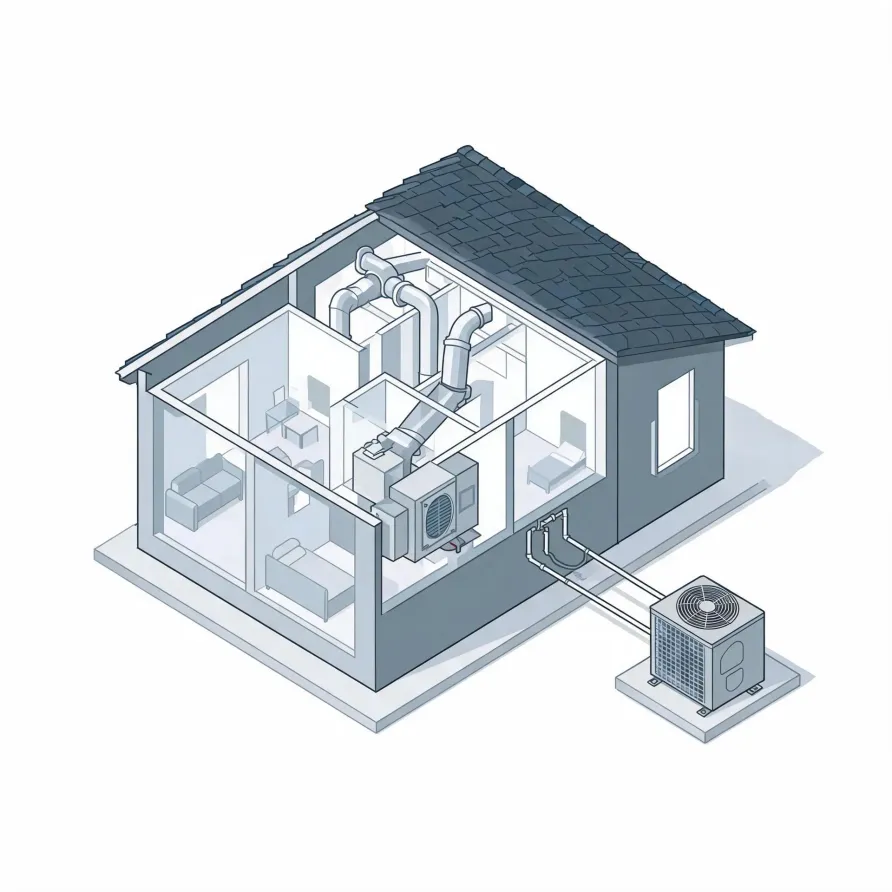
The outdoor condenser unit sits outside the house, usually on a concrete pad against an exterior wall, and it is where heat pulled from inside the home gets released. When it fails, rooms stop cooling even though the air handler is running. The compressor inside that cabinet is often where a contractor looks first.
The air handler lives in a mechanical room, basement, or attic and moves conditioned air through the house. Alongside it sits the evaporator coil, which is where refrigerant does its work and where a refrigerant leak or a frozen coil will show up. The expansion valve and the copper refrigerant lines connecting the two units round out what a contractor traces when something is off.
The drawing shows a typical central AC layout, and a licensed contractor determines which components apply to your specific house.
Find a contractor in Kennebec CountyKennebec County by the numbers
107 severe weather events were recorded in Kennebec County, Maine between 2015 and 2024.
NOAA National Centers for Environmental Information, Storm Events Database, bulk CSV export, events 2015-01-01 through 2024-12-31.Half the homes in Kennebec County, Maine were built in 1975 or earlier (2020-2024 ACS 5-year).
U.S. Census Bureau, 2020-2024 American Community Survey 5-Year EstimatesKennebec County, Maine holds 63,521 housing units (2020-2024 ACS 5-year).
U.S. Census Bureau, 2020-2024 American Community Survey 5-Year EstimatesOwners occupy 73.7% of the occupied homes in Kennebec County, Maine (2020-2024 ACS 5-year).
U.S. Census Bureau, 2020-2024 American Community Survey 5-Year EstimatesRules & Standards Governing Central AC Repair in Kennebec County, Maine9 sourced rules and standards
What HVAC Repair Actually Looks Like in Kennebec County
Split-system central air conditioners rated below 45,000 Btu/h manufactured on or after January 1, 2023 must meet a federal minimum of 13.4 SEER2.
Split-system central air conditioners rated at or above 45,000 Btu/h manufactured on or after January 1, 2023 must meet a federal minimum of 13.4 SEER2.
Split-system central air conditioners manufactured between January 1, 2015 and December 31, 2022 had to meet 13 SEER, the metric that preceded SEER2.
Single-package central air conditioners manufactured on or after January 1, 2023 must meet a federal minimum of 13.4 SEER2.
Space-constrained central air conditioners manufactured on or after January 1, 2023 must meet a federal minimum of 11.7 SEER2.
Federal efficiency standards for split-system central air conditioners and heat pumps are set on each certified combination of outdoor unit and indoor coil rather than on the outdoor unit alone.
Residential and light commercial air conditioning and heat pump systems assembled in the field, including mini-splits and unitary systems, may not be installed on or after January 1, 2025 using a refrigerant with a global warming potential above 700.
A field-assembled system whose specified components were all manufactured or imported before January 1, 2025 carries no installation compliance date under the refrigerant restrictions and may still be installed.
Licensing and Legal Requirements in Kennebec County, Maine
Maine licenses the fuel-burning side of heating rather than HVAC as a trade: a Maine Fuel Board licence is required to install or service solid fuel, oil, propane or natural gas burning equipment, including pellet-fired central heating appliances. Air conditioning is not named anywhere in the chapter.
Severe Weather Events in Kennebec County
Extreme weather puts real hours on cooling equipment. How hard a system works, and how often it fails, is shaped by local conditions, which is why the weather record for this area belongs on a page about AC repair.
107 severe weather events, 2015–2024. Source: NOAA National Centers for Environmental Information, Storm Events Database.