Tell us about the job
Takes about a minute. No obligation.
When a central AC compressor fails in Lincoln County, a contractor has to account for what that compressor has actually been asked to do. Homes in Lincoln County, ME have essentially no cooling season — no month of the year is warm enough to call for it. A system that almost never runs accumulates little wear on the contactor, the condenser fan motor, or the compressor itself. Long idle periods are harder on refrigerant seals and electrical connections than cycling is, so those are the places a contractor checks first. A compressor that fails here failed standing still, and the repair diagnosis shifts accordingly.
Half the homes in Lincoln County, Maine were built in 1978 or earlier (2020-2024 ACS 5-year). A central AC system sitting in a house from that era has often been swapped in to replace something older, which means the parts it takes are specific to a narrower window of manufacturing. When a contractor opens the unit, the question that shapes the repair bill is whether those components are still in production. Compressor replacements, control boards, and refrigerant fittings for older systems regularly trace back to discontinued lines, and that changes what a repair costs and sometimes whether repair is the right path at all.
The Parts of a Central AC a Contractor Checks First
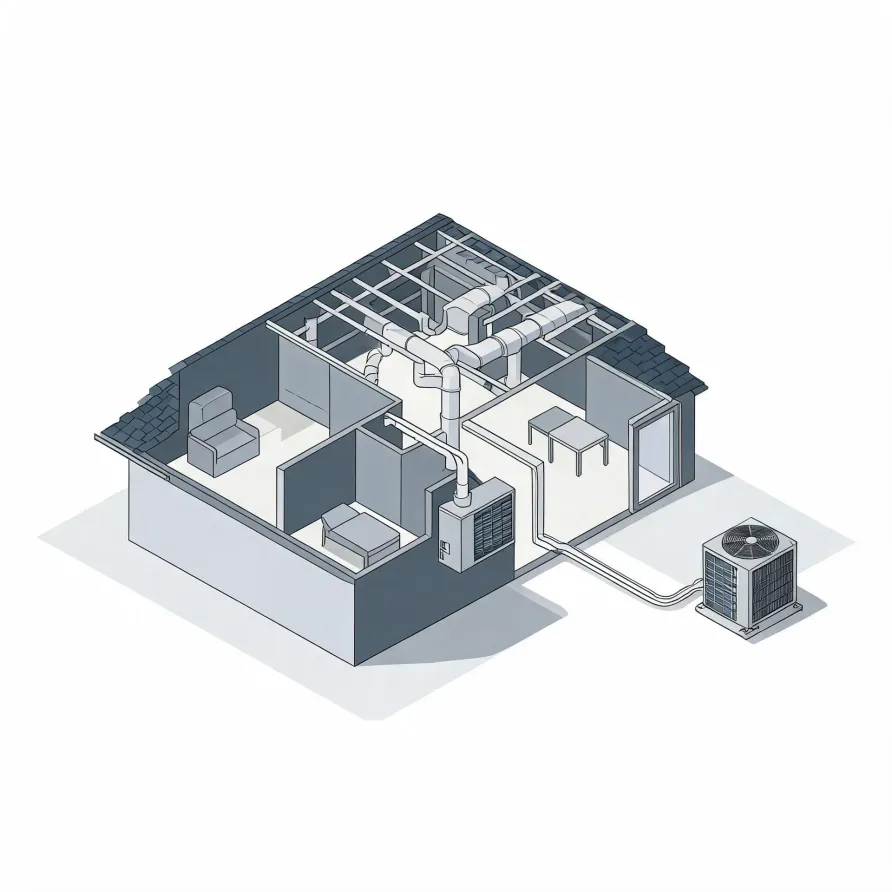
The outdoor condenser unit sits outside the house, usually on a concrete pad beside the foundation, and it carries the compressor and the condenser coil. These are the pieces a contractor reaches first when something has stopped working. A failed compressor, a coil blocked by debris, or a refrigerant leak will each shut the system down in its own way.
Inside the house, the air handler holds the evaporator coil and the blower. The air handler sits in a basement, utility closet, or attic and moves conditioned air into the duct system. A contractor also checks the expansion valve and the refrigerant lines that run between the two units, because a problem in those can look like a problem somewhere else.
The drawing shows the general layout of a central AC system, and a licensed contractor determines what applies to your specific house and equipment.
Find a contractor in Lincoln CountyLincoln County, Maine, by the numbers
67 severe weather events were recorded in Lincoln County, Maine between 2015 and 2024.
NOAA National Centers for Environmental Information, Storm Events Database, bulk CSV export, events 2015-01-01 through 2024-12-31.Half the homes in Lincoln County, Maine were built in 1978 or earlier (2020-2024 ACS 5-year).
U.S. Census Bureau, 2020-2024 American Community Survey 5-Year EstimatesLincoln County, Maine holds 23,922 housing units (2020-2024 ACS 5-year).
U.S. Census Bureau, 2020-2024 American Community Survey 5-Year EstimatesOwners occupy 82.5% of the occupied homes in Lincoln County, Maine (2020-2024 ACS 5-year).
U.S. Census Bureau, 2020-2024 American Community Survey 5-Year EstimatesCodes & Standards Governing Central AC Repair in Lincoln County, Maine9 sourced rules and standards
What happens when a contractor comes out for HVAC repair in Lincoln County
Split-system central air conditioners rated below 45,000 Btu/h manufactured on or after January 1, 2023 must meet a federal minimum of 13.4 SEER2.
Split-system central air conditioners rated at or above 45,000 Btu/h manufactured on or after January 1, 2023 must meet a federal minimum of 13.4 SEER2.
Split-system central air conditioners manufactured between January 1, 2015 and December 31, 2022 had to meet 13 SEER, the metric that preceded SEER2.
Single-package central air conditioners manufactured on or after January 1, 2023 must meet a federal minimum of 13.4 SEER2.
Space-constrained central air conditioners manufactured on or after January 1, 2023 must meet a federal minimum of 11.7 SEER2.
Federal efficiency standards for split-system central air conditioners and heat pumps are set on each certified combination of outdoor unit and indoor coil rather than on the outdoor unit alone.
Residential and light commercial air conditioning and heat pump systems assembled in the field, including mini-splits and unitary systems, may not be installed on or after January 1, 2025 using a refrigerant with a global warming potential above 700.
A field-assembled system whose specified components were all manufactured or imported before January 1, 2025 carries no installation compliance date under the refrigerant restrictions and may still be installed.
Licensing and Legal Requirements in Lincoln County, Maine
Maine licenses the fuel-burning side of heating rather than HVAC as a trade: a Maine Fuel Board licence is required to install or service solid fuel, oil, propane or natural gas burning equipment, including pellet-fired central heating appliances. Air conditioning is not named anywhere in the chapter.
Severe Weather Events in Lincoln County
Extreme weather puts stress on central AC systems: hard starts, sustained high-load runs, and sudden shutdowns that wear components faster than ordinary use does. How often that happens here shapes how much repair work the equipment in this area actually faces.
67 severe weather events, 2015–2024. Source: NOAA National Centers for Environmental Information, Storm Events Database.