Tell us about the job
Takes about a minute. No obligation.
A contractor quoting a central AC repair in Knox County has to establish why the equipment failed before pricing the job. Homes in Knox County, ME have essentially no cooling season — no month of the year is warm enough to call for it. A compressor that has started and stopped through cooling season after cooling season carries fatigue in its windings, its contactor, and its run capacitor. Here, that accumulation never happens. When a compressor fails, the contractor is looking at age, a factory defect, or a wiring fault rather than a worn-out machine that ran itself into the ground. The condenser fan and the refrigerant circuit deserve the same scrutiny, for the same reason.
Ducting sized and routed for older equipment, then adapted as systems changed, is what a contractor opens the job to. Half the homes in Knox County, Maine were built in 1974 or earlier (2020-2024 ACS 5-year). A system that has spent its life in a house that age accumulates wear specific to that history: refrigerant components stressed by years of seasonal demand, capacitors and contactors that have cycled past their rated life, and compressor internals that need parts a contractor has to source carefully because some are no longer manufactured. When a repair call comes in, what the opened unit contains decides the scope, and in stock like this, sourcing is often where the job stalls.
The Parts of a Central AC a Contractor Checks First
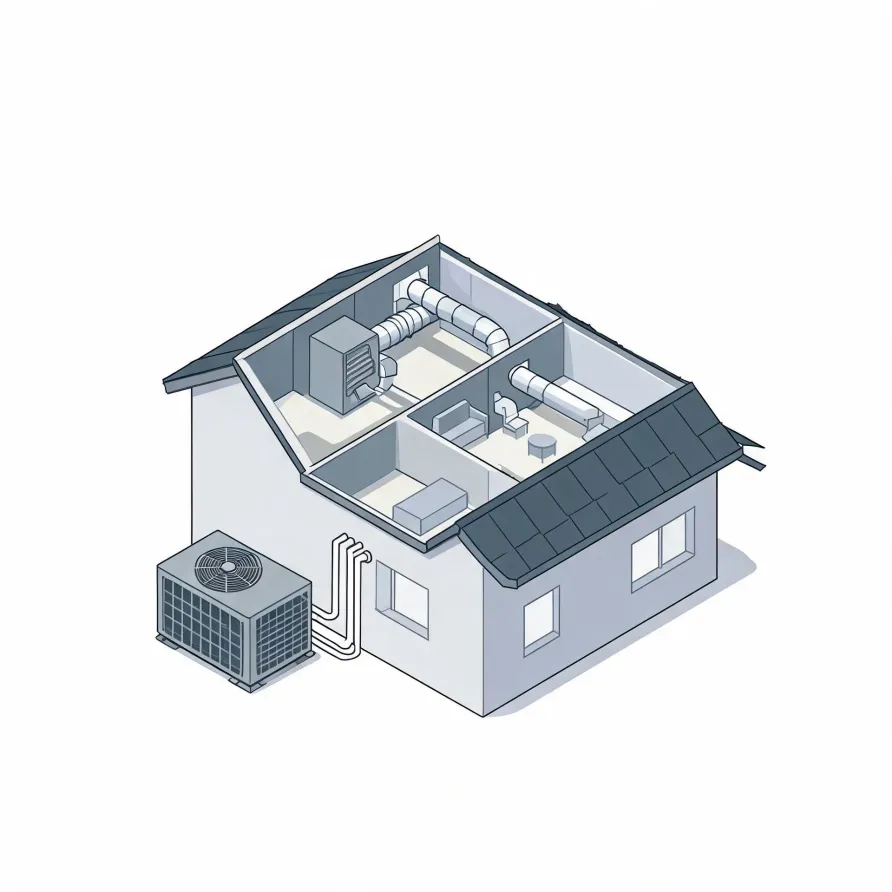
The outdoor condenser unit sits outside the house, usually on a concrete pad at the side or rear, and it is where heat gets expelled from the system. A contractor starts here because the compressor inside it and the condenser coil wrapped around it are common sources of failure. The indoor air handler, which lives in a basement, utility closet, or attic, holds the evaporator coil and the blower that moves air through the house.
The refrigerant lines run between the two units, carrying the working fluid that makes the whole system function, and a leak anywhere along them will stop a Central AC from doing its job. The expansion valve and the capacitors that help the motors start and run are also points a contractor works through when tracing a fault.
The drawing shows a typical Central AC layout, and a licensed contractor determines which components and connections apply to your specific house.
Find a contractor in Knox CountyKnox County, Maine, by the numbers
71 severe weather events were recorded in Knox County, Maine between 2015 and 2024.
NOAA National Centers for Environmental Information, Storm Events Database, bulk CSV export, events 2015-01-01 through 2024-12-31.Half the homes in Knox County, Maine were built in 1974 or earlier (2020-2024 ACS 5-year).
U.S. Census Bureau, 2020-2024 American Community Survey 5-Year EstimatesKnox County, Maine holds 24,564 housing units (2020-2024 ACS 5-year).
U.S. Census Bureau, 2020-2024 American Community Survey 5-Year EstimatesOwners occupy 78.7% of the occupied homes in Knox County, Maine (2020-2024 ACS 5-year).
U.S. Census Bureau, 2020-2024 American Community Survey 5-Year EstimatesCode & Licensing Record for Central AC Repair in Knox County, Maine9 sourced rules and standards
What Happens When the Contractor Comes Out
Split-system central air conditioners rated below 45,000 Btu/h manufactured on or after January 1, 2023 must meet a federal minimum of 13.4 SEER2.
Split-system central air conditioners rated at or above 45,000 Btu/h manufactured on or after January 1, 2023 must meet a federal minimum of 13.4 SEER2.
Split-system central air conditioners manufactured between January 1, 2015 and December 31, 2022 had to meet 13 SEER, the metric that preceded SEER2.
Single-package central air conditioners manufactured on or after January 1, 2023 must meet a federal minimum of 13.4 SEER2.
Space-constrained central air conditioners manufactured on or after January 1, 2023 must meet a federal minimum of 11.7 SEER2.
Federal efficiency standards for split-system central air conditioners and heat pumps are set on each certified combination of outdoor unit and indoor coil rather than on the outdoor unit alone.
Residential and light commercial air conditioning and heat pump systems assembled in the field, including mini-splits and unitary systems, may not be installed on or after January 1, 2025 using a refrigerant with a global warming potential above 700.
A field-assembled system whose specified components were all manufactured or imported before January 1, 2025 carries no installation compliance date under the refrigerant restrictions and may still be installed.
Licensing and Legal Requirements in Knox County, Maine
Maine licenses the fuel-burning side of heating rather than HVAC as a trade: a Maine Fuel Board licence is required to install or service solid fuel, oil, propane or natural gas burning equipment, including pellet-fired central heating appliances. Air conditioning is not named anywhere in the chapter.
Severe Weather Events in Knox County
Storms put hours on a central AC system that routine summers never would. A compressor cycling hard through power fluctuations and heat spikes wears differently than one running steady, and repair needs in Knox County reflect what the weather here actually does.
71 severe weather events, 2015–2024. Source: NOAA National Centers for Environmental Information, Storm Events Database.